
Blog
11th July 2025
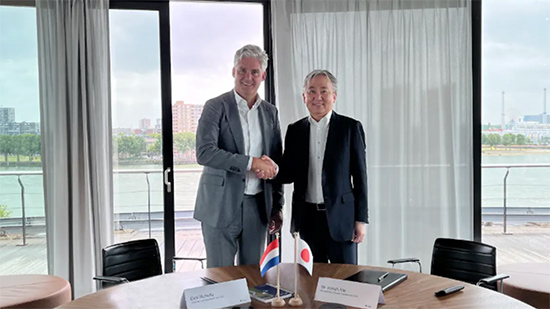
Image Source: IHI Corporation
IHI Corporation and GE Vernova have jointly opened a large-scale ammonia combustion test facility at IHI’s Aioi Works in Hyogo Prefecture, Japan. The new site is built to simulate full-scale operational conditions of gas turbines, marking a critical step in the two companies’ efforts to develop 100 percent ammonia-capable gas turbine technology by 2030.
This facility enables performance validation of ammonia combustors under conditions such as high temperature, high pressure, and precise airflow dynamics that mirror those in actual F-class gas turbines. The project supports the joint technology roadmap of IHI and GE Vernova, which focuses on decarbonizing gas-based power generation using zero-carbon fuels like ammonia.
Kensuke Yamamoto, Executive Officer and General Manager of the Ammonia Value Chain Project at IHI, stated, “This milestone marks a significant step forward in the joint technology roadmap aiming to lead to a 100 percent ammonia-capable combustion system by 2030. IHI has developed a 100 percent ammonia firing gas turbine IM270 and will level the technology to develop large-scale combustion technology. The facility will be a crucial hub for IHI’s and GE Vernova’s project.”
The joint development agreement, signed in 2024, targets deployment of ammonia combustion systems for GE Vernova’s 6F.03, 7F, and 9F gas turbine models. Testing at the facility is scheduled to begin in mid-2025 and will include flame stability, NOx control, combustion efficiency, and durability assessments.
Jeffrey Goldmeer, Senior Director of Technology Strategy at GE Vernova, emphasized the transition from R&D to applied engineering. He noted, “This announcement signals a shift from initial studies on the ammonia value chain to the practical implementation of technologies and engineering projects, aiming to decarbonize power generation by using ammonia as a fuel. This marks a new phase of collaboration between GE Vernova and IHI.”
One of the main engineering challenges with ammonia is managing nitrogen oxide emissions during combustion. Ammonia contains nitrogen, and under high-temperature conditions it can form nitrogen-based pollutants. IHI and GE Vernova are addressing this using a two-stage combustion process. In the first stage, ammonia is burned under fuel-rich conditions to suppress NOx formation. In the second stage, excess air completes the combustion process, ensuring efficiency while minimizing emissions.
IHI has previously demonstrated successful ammonia combustion at a 2 megawatt scale with its IM270 turbine model. This served as a foundation for scaling the technology to larger turbine platforms now being tested.
Ammonia’s role as a clean fuel is growing. It contains no carbon, meaning it produces zero CO2 when burned. It is also easier to store and transport than hydrogen, making it a practical energy carrier for the power sector. These advantages have drawn interest from utilities, governments, and industrial players looking to decarbonize power generation without replacing existing gas infrastructure.
Japan has positioned itself at the forefront of ammonia energy development, with national plans to co-fire ammonia in coal and gas power plants and eventually deploy dedicated ammonia-burning power systems. The new Hyogo facility will be a vital enabler for Japan’s clean energy goals and could play a key role in exporting the technology globally.
Looking forward, GE Vernova and IHI also plan to explore retrofit applications for existing plants. One candidate is the Sakra combined cycle power plant in Singapore, which already uses GE turbines and could adopt ammonia as a fuel under this program.
Goldmeer added, “Ammonia combustion technology will be an important part of a diverse decarbonization toolkit. Working with IHI gives us the opportunity to validate these systems in realistic environments, allowing us to move faster toward commercial deployment.”
The long-term vision includes fully commercial 100 percent ammonia-fired turbines available by the end of this decade. These systems would offer utilities a low-carbon alternative to gas, without compromising on performance or reliability.
For access to detailed project data, custom market intelligence, or to discuss how we can support your strategic goals, get in touch with our team.